20+ yearstelemetry since 2005
Soil Moisture Monitoring
Measure soil moisture continuously and in real time, at multiple depths and multiple points across a property. See exactly how much water is available to the root zone — not just what was applied at the surface.
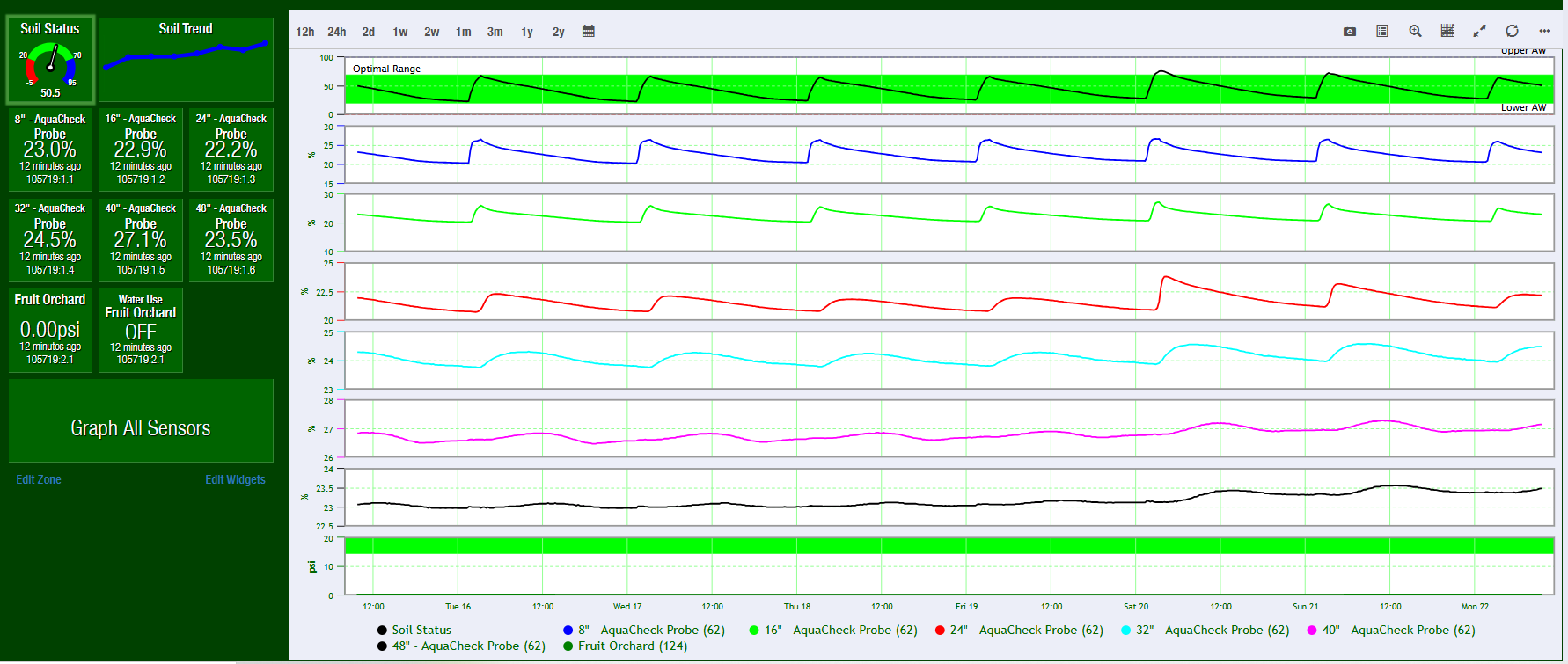
Single or multi-level probes report moisture, temperature, and salinity continuously to myRanch — no manual readings, no guessing. View data as a time graph, or as a color-coded "Soil Moisture Profiler" showing a full cross-section of the root zone over time.
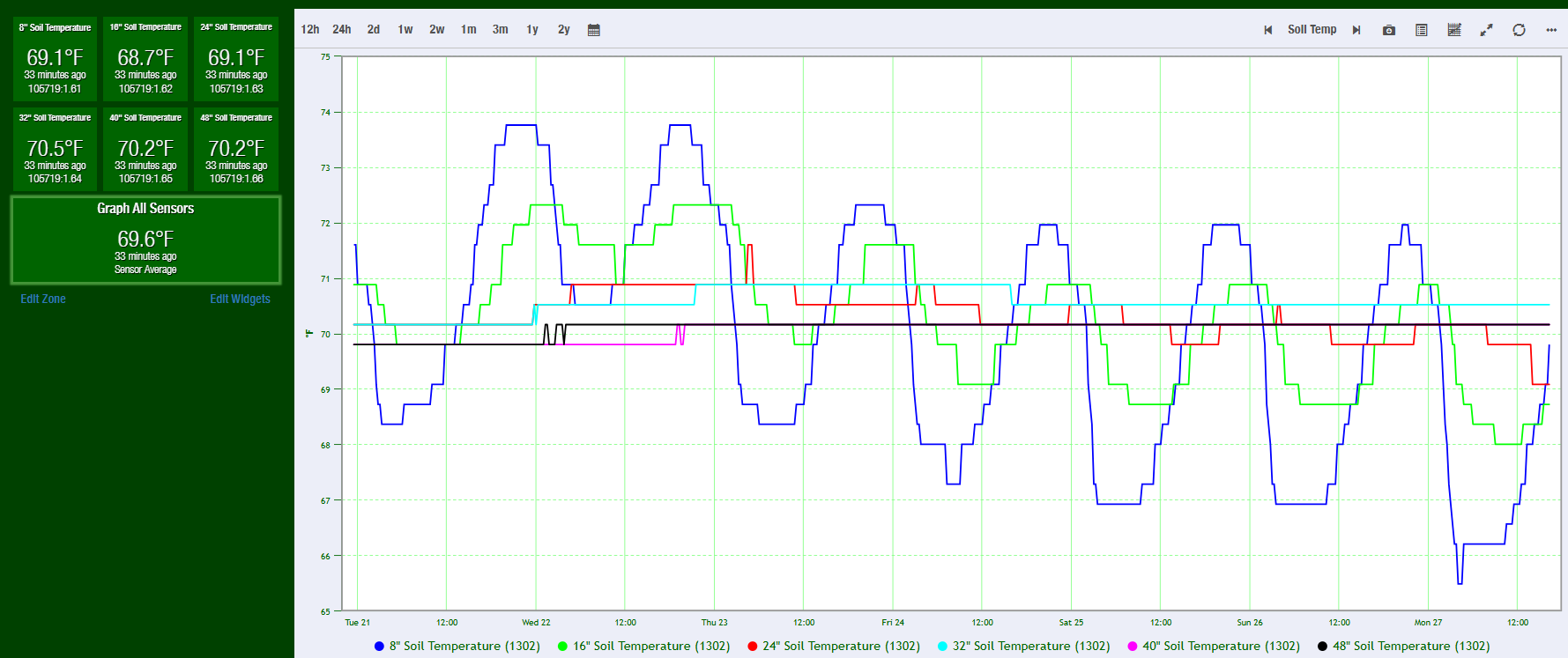
Temperature drives root activity and nutrient uptake just as much as moisture does. myRanch tracks temperature alongside moisture at every probe depth, so you can see how heat is moving through the soil profile over time — not just what's happening at the surface.
A single reading at one depth can hide what's really happening in the root zone — moisture near the surface can look adequate while deeper roots are already going dry, or vice versa. Multi-level probes report each depth separately, so you can see exactly where water is available and where it isn't, and adjust irrigation timing and duration accordingly.
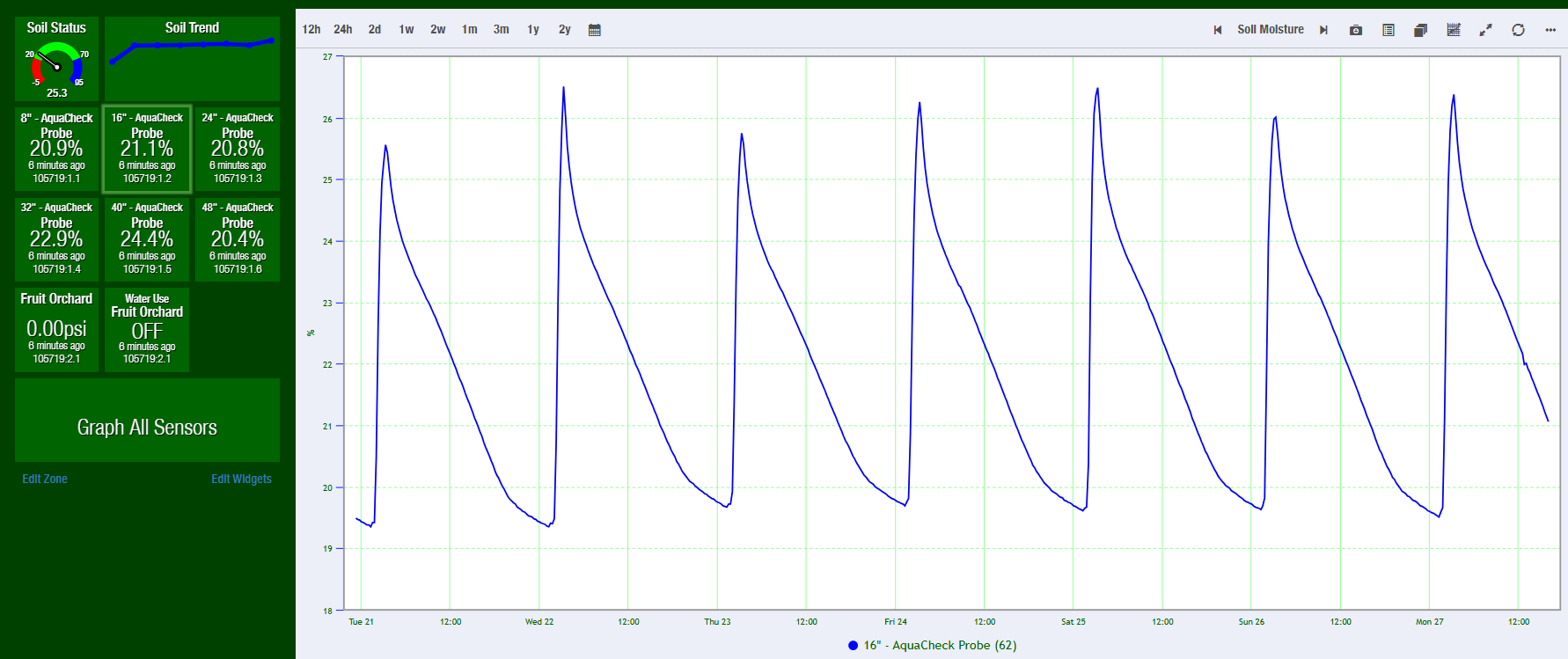
Soil moisture varies widely with soil type, slope, and depth — a single probe can make a whole block look fine while other zones are already stressed. Deploying multiple measurement points across a property keeps the picture accurate, so irrigation decisions reflect what's actually happening in the ground, not just at one sensor.
After harvest, water is often already drawn down for the season while trees still need heavy recovery irrigation to rebuild reserves for the following year. Deep soil moisture data shows whether long irrigation sets are actually reaching the root zone — so growers can confirm recovery is working instead of guessing from surface conditions alone.
Ranch Systems telemetry reads a wide range of third-party soil moisture, temperature, and EC probes over SDI-12 — including TEROS 12, AquaCheck, and similar industry-standard sensors — so existing equipment can be brought onto the platform without replacing what's already in the ground.
AquaCheck probes can report multiple depths on a single probe — the number of levels depends on the probe length ordered.
Common Questions
In most cases you can keep them. Ranch Systems telemetry reads third-party soil probes over SDI-12 and Modbus RTU (RS-485), including METER Group TEROS 12, AquaCheck, Sentek Drill & Drop, and WaterMark granular matrix sensors. Probes already installed in the ground can usually be brought onto the platform without pulling or replacing them.
If a sensor outputs a standard signal — SDI-12, Modbus RTU over RS-485, 4–20 mA, 0–5 V analog, pulse, or dry contact — there's a good chance it will connect. See the full compatible sensor list →
A probe needs to sit in two things at once: the active root zone and the wetting pattern of an irrigation emitter. Being in one but not the other is the most common placement mistake, and it quietly produces misleading data.
In tree and vine crops, that generally means installing within the drip edge of the canopy — which is also where root activity is highest — with an emitter in close proximity to the probe. A probe placed hard against the trunk, or set back from the drip line, will read the soil but won't represent what the roots are actually getting.
Secure the drip line so the relationship doesn't drift. Pulling the line over and stapling it down keeps the emitter in the same position relative to the probe through the season, instead of migrating away from it during equipment passes.
A single reading at one depth can hide what's really happening in the root zone — moisture near the surface can look adequate while deeper roots are already going dry, or the reverse. Multi-level probes report each depth separately, so you can see exactly where water is available and where it isn't.
AquaCheck and Sentek Drill & Drop probes report multiple depths on a single probe; the number of levels depends on the probe length ordered. In myRanch you can view each depth as a time graph, or as a color-coded Soil Moisture Profiler showing a full cross-section of the root zone over time.
Yes. RS330 units can link together into a RanchMesh™ network, relaying data from node to node until it reaches one with a usable signal — built specifically for large or cellular-poor properties. Separately, the RS10 connects probes wirelessly over long-range Bluetooth® up to 1,000 feet from a host telemetry unit, so the probe location itself doesn't need coverage.
Where a site has no connectivity at all, the same RS10 hardware can run as a standalone RS10 data logger — logging readings locally and downloading them over Bluetooth to a phone, tablet, or laptop on your next visit.
Watch the deeper sensors respond after a set. A long irrigation can wet the surface without water ever reaching depth — and surface conditions alone won't tell you which happened. Because multi-level probes report each depth continuously, you can see water move down through the profile after an event and confirm it arrived where the roots actually are.
This matters most during post-harvest recovery, when water is often already drawn down for the season but trees still need heavy irrigation to rebuild reserves for the following year. Deep soil moisture data shows whether those long sets are reaching the root zone instead of leaving it to guesswork.
Check the probe's placement before you change your irrigation. A probe sitting in the active root zone but outside the emitter's wetting pattern produces exactly this signature — moisture registering near the surface, around the 8-inch mark, getting progressively drier with depth — even when irrigation is adequate. It reads like a penetration problem when it's really a placement problem.
The color-coded Soil Moisture Profiler makes the difference obvious at a glance. We've seen a probe pulled and reinstalled into the wetting pattern show good moisture penetration through the full profile immediately afterward — same sensor, same irrigation practice, only the placement changed.
If placement is already correct and the deeper readings still aren't responding after a set, then the irrigation genuinely isn't reaching depth and set duration is worth looking at.
Moisture, temperature, and salinity (EC) — which of the three you get depends on the probe. Temperature is tracked at every probe depth, because it drives root activity and nutrient uptake just as much as moisture does, so you can see how heat moves through the soil profile over time rather than only at the surface.
Salinity requires a probe that measures EC, such as the METER Group TEROS 12 or the Sentek Drill & Drop TriSCAN.
Either — it's your choice. You can run soil moisture purely as monitoring and irrigate on your own judgment, or feed it into an irrigation program so watering responds to what the root zone is actually reporting.
Used that way, live conditions can hold back, shorten, or skip a scheduled set — so a block that's still wet doesn't get watered just because it's on the calendar. Programs also confirm the valve actually operated, and use flow and pressure readings to verify water was delivered rather than assuming it. You can override anything in real time from a browser or the mobile app.
Conversations you start here will show up in this list.