20+ yearstelemetry since 2005
Ranch Systems Solutions
Complete visibility and control for your irrigation, soil, weather, and field equipment — on one platform built for growers.
Irrigating large, multiple, or remote properties is labor-intensive, and it is often hard to know whether valves actually opened or the right amount of water was delivered. myRanch manages the full cycle — valve activation, flow measurement, and soil-moisture tracking — for monitoring only or full remote control and scheduling.
Click to flip
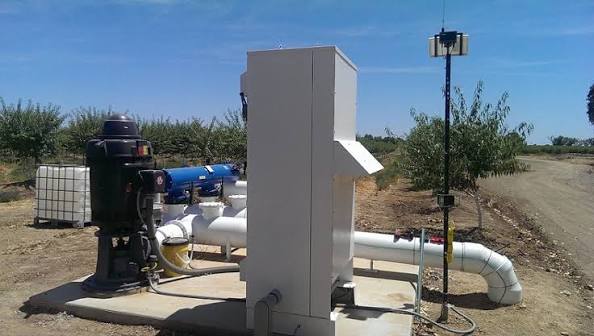
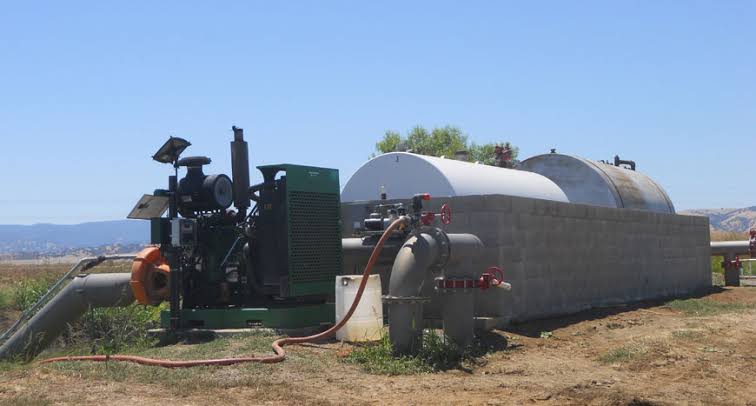
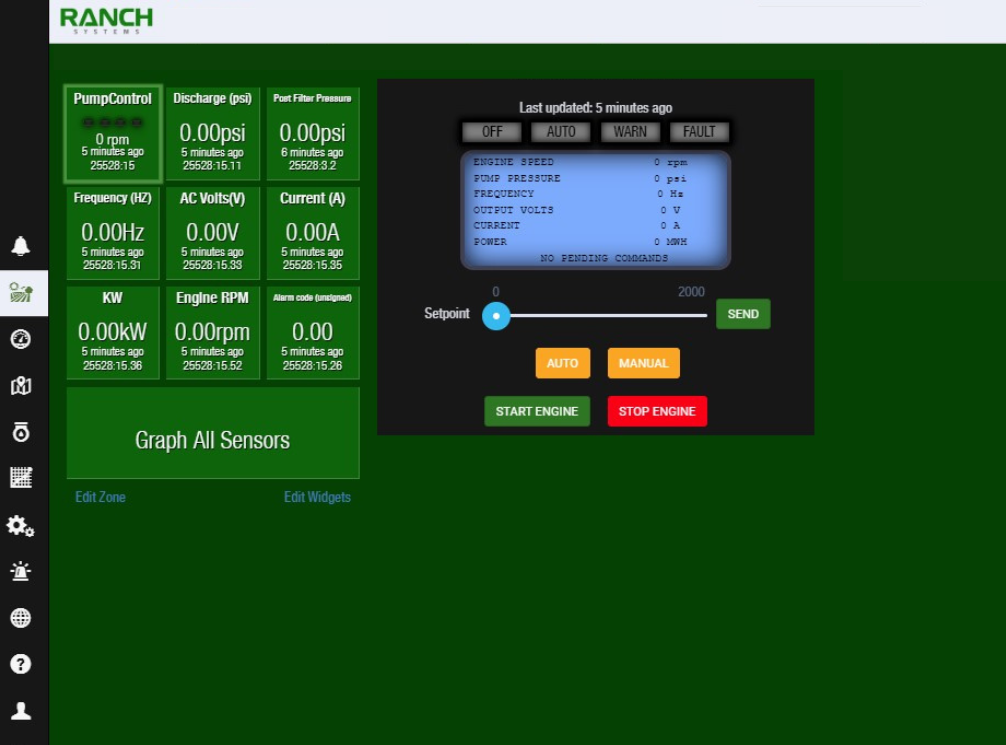
Remotely monitor and control pumps — electric or engine-driven — from simple on/off pressure monitoring to full engine statistics with start/stop. The most advanced control comes through the Ranch Systems partnership with Murphy, letting any suitable Murphy-controlled engine be run online.
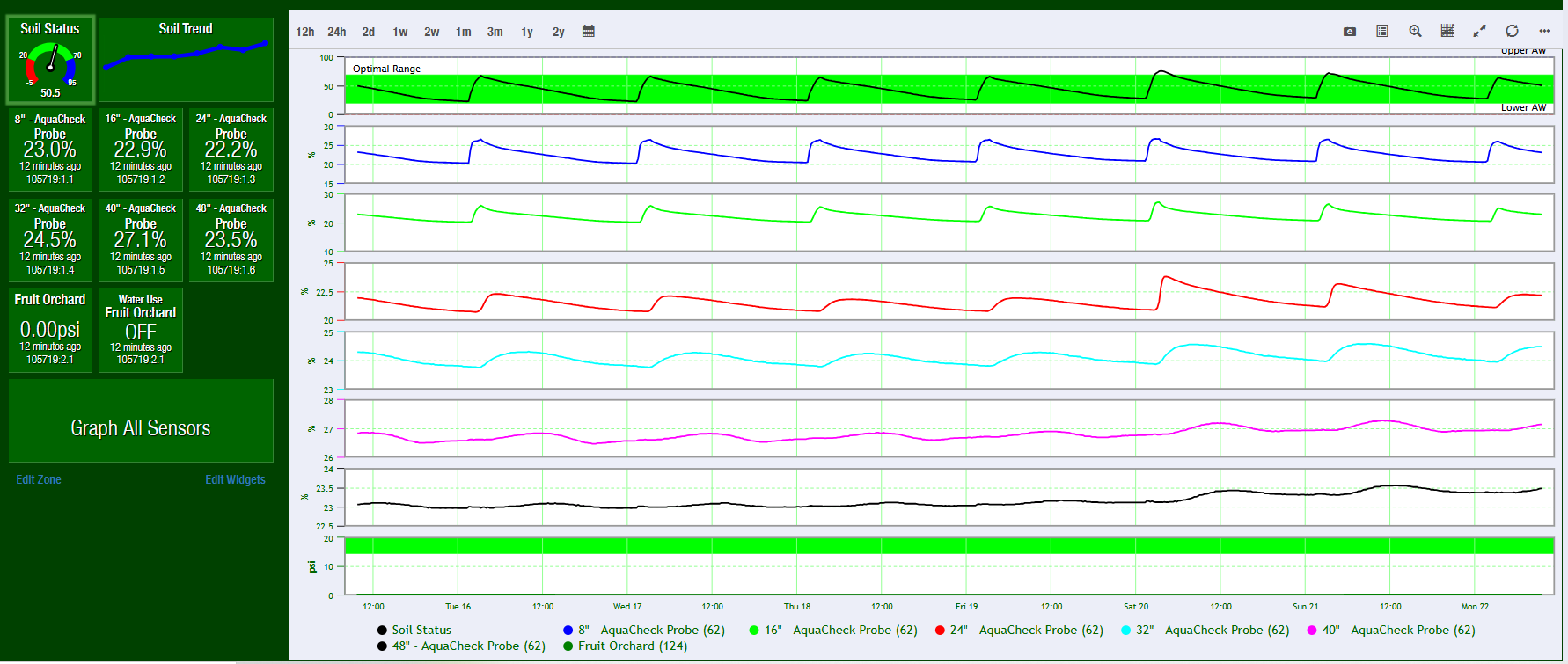
Measure soil moisture continuously and in real time at multiple depths and multiple points across a property. Use the data to schedule irrigation, trigger critical-level alerts, or build a smarter irrigation basis by combining it with climate and water-resource information.
Because moisture varies widely with soil type and terrain, multiple measurement points keep your picture accurate. View readings as a time graph or as a unique color-coded "Soil Moisture Profiler" showing a cross-section of the profile over time.
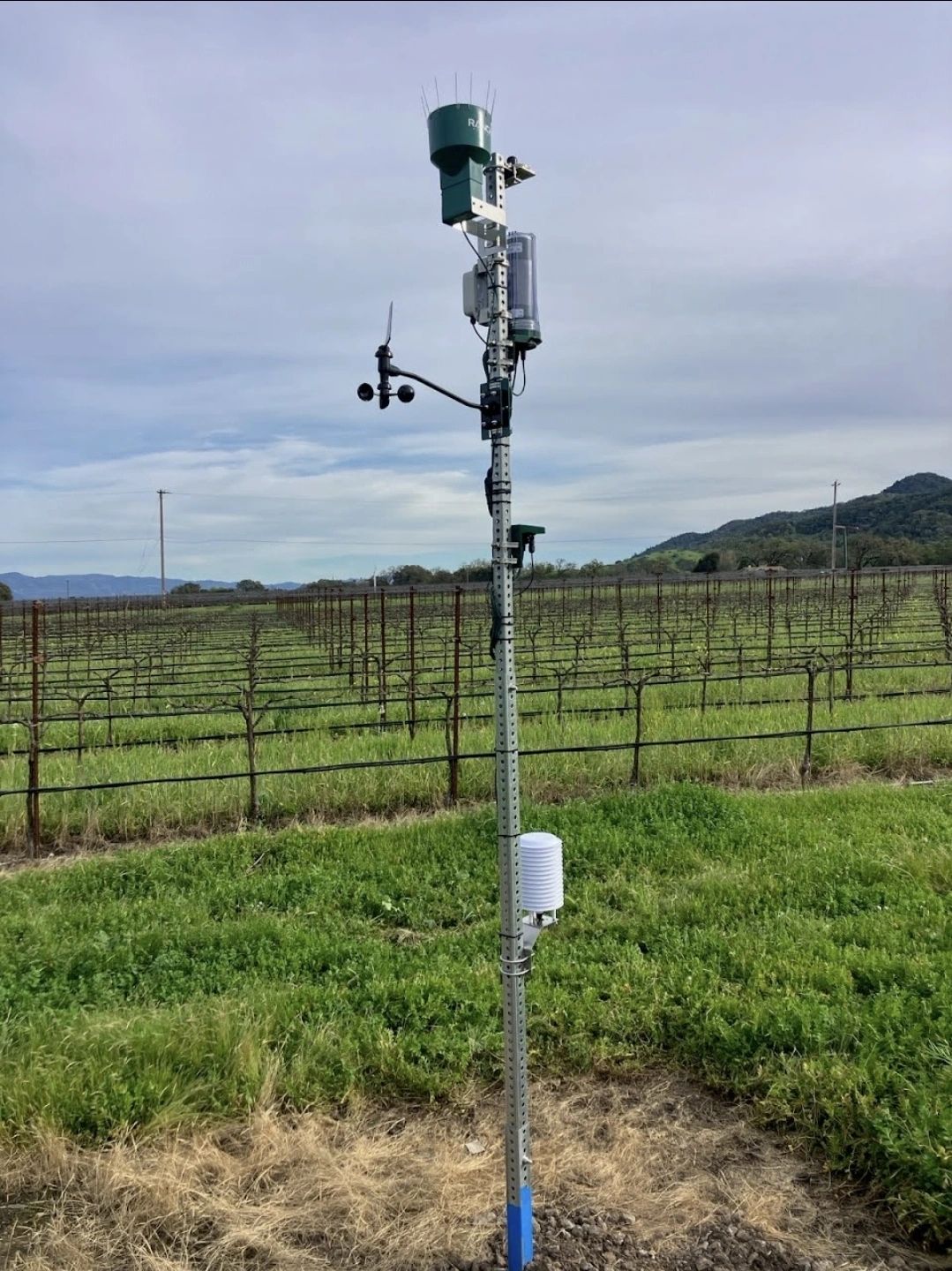
On-site weather stations feed real-time data directly into your irrigation decisions — temperature, humidity, wind speed, rainfall, and evapotranspiration (ET) calculations for the most accurate scheduling possible.
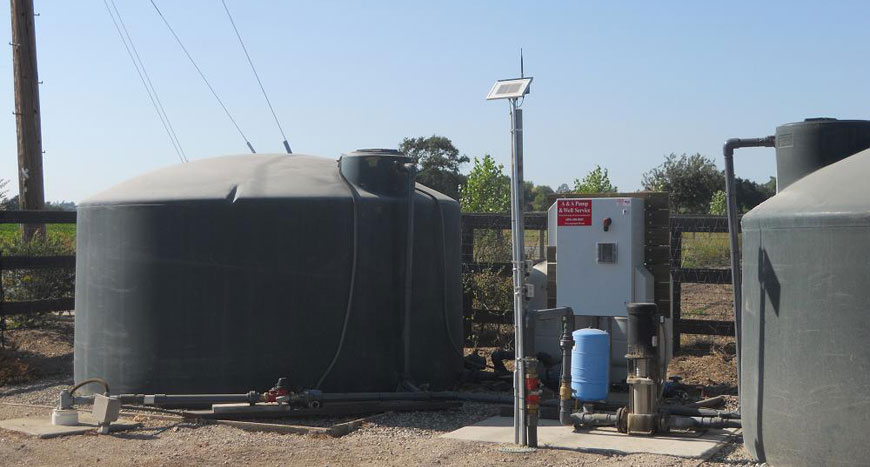
Monitor the level of tanks, ponds, wells, and other liquid storage — including fuel and fertilizer — using submersible pressure or ultrasonic sensors. The software calculates volume from tank geometry, and alerts can even trigger a shutoff valve or alarm horn automatically.
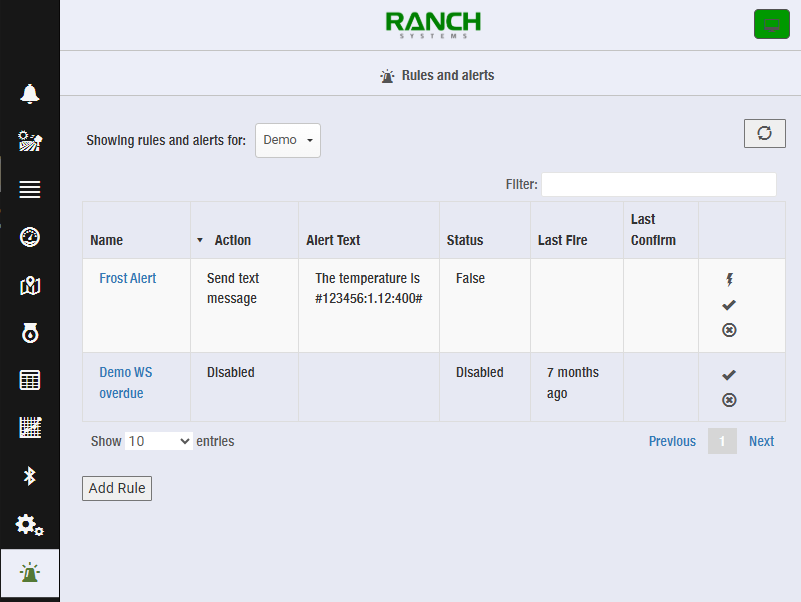
Early detection of problem conditions, with rules and recipients defined by you. Triggers can be as simple as "temperature < 38" for frost or a complex calculated formula. Delivery is by email, text, or voice, and the system can call multiple recipients repeatedly until one acknowledges — minutes can mean millions.
Unlike web-cams that stream constantly, myRanch cameras capture still images at intervals — or on a motion or keypad event — and economically transmit them to the cloud. Images appear in a calendar view, making it easy to pinpoint activity at a site, track crop development, or feed a live snapshot to your own website.
Full platform capabilities
Ranch Systems supports the full spectrum of agricultural monitoring — from a single weather station to a multi-property network spanning dozens of sensor types. Below is the complete list of what the platform tracks and controls.
Weather
Tipping-bucket rain gauges capture precipitation continuously and transmit totals in real time. Track daily, storm, and seasonal accumulations alongside evapotranspiration to inform irrigation scheduling and build a long-term rainfall record for your property.
Weather
Cup anemometers and wind vanes record speed and direction at configurable intervals. Alerts fire when gusts exceed safe spray thresholds. Vineyard managers use wind data to select frost protection timing and monitor burn events.
Weather
Aspirated temperature and relative humidity sensors produce continuous, shelter-grade readings at any point across your property. Data feeds directly into disease models, wet-bulb calculations, and heat-index alerts — all visible in real time on the myRanch dashboard.
Weather
Temperature thresholds trigger immediate SMS, email, or voice alerts when conditions approach frost risk. Alerts can be set per block or microclimate zone, and the system calls multiple recipients in sequence until one acknowledges — critical when minutes determine crop survival.
Weather
Leaf wetness sensors measure surface moisture duration — a primary input for disease risk models covering powdery mildew, botrytis, and other common pathogens. Pairing leaf wetness with temperature gives growers an accurate local disease pressure reading rather than relying on regional averages.
Weather
Pyranometers log incident solar radiation at the canopy level, powering evapotranspiration (ET) calculations and canopy energy models. UV sensors support sunburn risk assessment for sensitive varieties and can feed into spray-window planning.
Disease & Pest
Computed from on-site temperature readings, the mildew index flags rising infection risk in real time — specific to your block, not a regional average — so sprays go out on an actual risk window instead of a fixed calendar schedule.
Disease & Pest
Leaf wetness duration paired with temperature drives the botrytis risk model, giving growers an early, local warning of bunch rot and gray mold pressure rather than relying on a regional forecast.
Disease & Pest
Leaf wetness and temperature data feed an Alternaria risk model tuned to your microclimate, surfacing infection-risk windows for this common leaf-spot pathogen as they develop on-site.
Disease & Pest
The Cougar Blight model combines leaf wetness, rainfall, and temperature to flag fire blight infection risk in pome fruit — early enough to time a bactericide application before symptoms appear.
Disease & Pest
A degree-day model tracks peach twig borer development in almonds from on-site temperature data, predicting emergence timing so treatments target the actual pest cycle on your ranch.
Disease & Pest
Beyond any single pest, the platform predicts days remaining until a grower-set growing-degree-day threshold is reached — an early heads-up for scouting and treatment planning, not just a running total.
Pollinator & Spray Safety
Wind speed, temperature, and rainfall combine into a bee flight activity model, helping growers identify safe spray windows that avoid active pollinator hours and reduce off-target harm.
Weather
Accumulated degree days, chill hours, and chill portions are calculated automatically from on-site temperature readings. Track pest development cycles, dormancy accumulation, and bloom timing with data tied to your actual microclimate rather than a regional station miles away.
Soil
Continuous, real-time volumetric water content readings at single or multiple depths let growers irrigate based on actual plant-available water rather than schedule alone. Supports a wide range of third-party capacitance and tensiometer probes.
Soil
Soil temperature probes track root-zone temperature at multiple depths — useful for tracking degree-day accumulation below ground, monitoring mulch effectiveness, and timing cover-crop termination or fertilizer application.
Soil
The myRanch Soil Moisture Profiler renders a color-coded cross-section of moisture by depth over time, making it easy to see how wetting fronts move through the soil, identify compaction layers, and confirm that irrigation water is reaching the root zone.
Soil
Combine soil moisture data with ET-based crop water demand models to compute a real-time water deficit for each zone. Schedule irrigation precisely to refill the root zone without over-applying — reducing water use while maintaining vine or crop stress targets.
Irrigation
Create and modify irrigation schedules from any device, anywhere. The Ranch Systems base station executes schedules autonomously even without internet connectivity, then syncs status back to the cloud — so a dropped connection never leaves valves stranded mid-cycle.
Irrigation
Wireless nodes reach remote valve manifolds across large or irregular properties without expensive wire runs. Run individual zones or complex multi-zone programs, and pair with soil moisture feedback to automatically adjust set times based on current conditions.
Irrigation
Inline flow sensors confirm that the right volume of water was delivered each set — and immediately alert if a valve failed to open, a line broke, or a pump delivered below target flow. Accumulated flow logs feed into water-use reporting and district compliance records.
Pump & Power
Monitor run status, discharge pressure, amp draw, and run hours on electric pumps. Set alerts for overcurrent or pressure drop conditions before failures occur, and toggle pumps on or off remotely without sending anyone to the field.
Pump & Power
Through the Ranch Systems partnership with Murphy Engine Controls, diesel and natural-gas engine pumps can be started, stopped, and diagnosed remotely. Real-time engine stats — RPM, temperature, oil pressure, run hours — are logged and visible on the myRanch dashboard.
Pump & Power
Track well pump run time, water level drawdown, and recovery rates over time. Early detection of declining well yield or pump wear helps avoid the irrigation failures that occur when a well can't keep pace with peak seasonal demand.
Storage
Submersible pressure transducers or ultrasonic sensors report tank level and calculated volume continuously. Set high and low alerts, generate usage graphs, and schedule delivery trucks with precision — eliminating guesswork and preventing the crop losses that follow an unexpected dry tank.
Storage
Monitor open-water storage — ponds, lined reservoirs, canals — with the same sensor suite used for tanks. Volume calculations account for non-linear geometry, and historical level graphs help quantify seepage rates and seasonal carry-over storage.
Storage
The same level-monitoring infrastructure tracks fuel and liquid fertilizer storage alongside water. Alerts when tanks run low prevent equipment downtime and missed fertigation windows — and consumption logs tie into operational cost reporting.
Visibility
Still-image cameras transmit photos on a schedule or triggered by motion, delivering a visual record of any site without the bandwidth and cost of continuous streaming. Images are searchable in a calendar view and can be embedded as live snapshots on your own website.
Visibility
Interval photography across the growing season builds a searchable visual record of canopy development, cover-crop growth, and post-harvest conditions. Growers use these archives to calibrate timing decisions for the following year and document compliance with premium certification programs.
Alerts
Define alerts using simple thresholds or multi-variable formulas on any sensor in the system. Deliver by email, SMS, or voice call to any number of recipients, with escalating callbacks until someone acknowledges. Rules can trigger valve shutoffs, horn outputs, or auto-start sequences — not just notifications.
Conversations you start here will show up in this list.