
20+ yearstelemetry since 2005
Tank & Pond Monitoring
Monitor the level of tanks, ponds, wells, and other liquid storage — including fuel and fertilizer — using submersible pressure or ultrasonic sensors, with volume calculated automatically from tank geometry.
Submersible pressure or ultrasonic sensors report tank level continuously, and the software calculates volume from tank geometry automatically — no manual dipping, no guesswork.
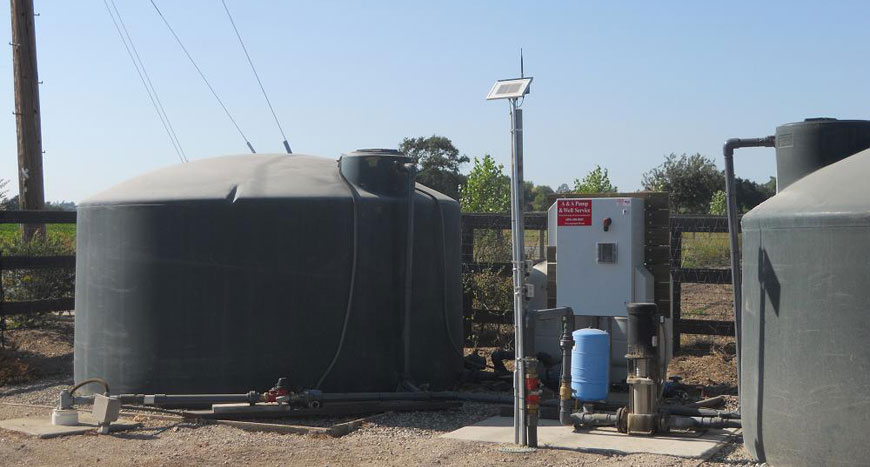
Ranch Systems telemetry reads a wide range of tank and well level sensors — submersible pressure transducers from 0–250 PSI up to 0–500 PSI, submersible level sensors with 50 ft or 100 ft cables, deep well sensors to custom depths of 690 ft, and well bubbler sensors — so there's a sensor that fits your storage depth and type.
Common Questions
Both are supported, and the right choice depends on the installation. Submersible pressure transducers sit in the liquid and measure depth directly — available from 0–250 PSI up to 0–500 PSI, with deep well sensors reaching custom depths to 690 ft. Ultrasonic and bubbler sensors measure level without contacting the liquid, which can be a better fit for fuel, fertilizer, or hard-to-access wells.
Your reseller can help match the sensor to your tank or well. See the full compatible sensor list →
All three. The same level-monitoring infrastructure tracks fuel and liquid fertilizer storage alongside water — alerts when those tanks run low help prevent equipment downtime and missed fertigation windows, and consumption logs tie into operational cost reporting.
Yes. Ponds, lined reservoirs, and canals use the same sensor suite as tanks, with volume calculations that account for non-linear geometry — useful for tracking seepage rates and seasonal carry-over storage.
Yes. Alerts aren't limited to a notification — a level reading can trigger a shutoff valve or alarm horn automatically, so an overfill or a dangerously low tank gets an immediate physical response.
Yes. Wells use the same submersible or ultrasonic level sensors, with discharge measured through any pulse-output flow meter, so well data lands in the same dashboard as your tanks and ponds.
Before. You can set high and low-level alerts on every tank, so you're notified while there's still time to act — to schedule a delivery truck, adjust a pump, or investigate a leak — instead of finding out only after it's already empty or overflowing.
Conversations you start here will show up in this list.